A high usage alert from a smart water meter is a starting point, not a diagnosis. How to read what the meter is actually telling you, rule out ordinary household use, run the isolation test that settles it, and work out whether the pipe is yours to fix.
A smart water meter that reports high usage has noticed something. It has not diagnosed anything. The alert covers a genuine hidden leak, a toilet that has been refilling quietly for a month, a guest staying for a fortnight, a garden hose left on a timer and a meter reading error, and the alert itself does not distinguish between them.
The good news is that the difference can be settled at home in under an hour with no equipment. What follows is the sequence: what the meter is actually measuring, how to rule out ordinary use, the isolation test that gives a yes or no answer, how to narrow down the source once you have one, and how to work out whether the pipe is yours to fix in the first place.
What a High Usage Alert Is Actually Measuring
Smart meters do not see leaks. They see volume passing through the meter, logged at intervals, and a rule applied to that log. The rule is usually one of two things, and knowing which one triggered is the single most useful piece of information you have.
Continuous flow versus a spike
A continuous flow alert means water passed the meter in every reporting interval over a defined period, typically including the small hours. That is the alert worth taking seriously, because almost nothing in a normal household draws water for twenty-four hours without stopping. A high volume alert without continuous flow is different. It means more water than usual went through the meter, but it stopped at some point, which points at usage rather than a leak.
How often the meter reports, and why that matters
Reporting intervals differ between suppliers and between meter types, and an alert can arrive days after the event that caused it. Before drawing any conclusion, look at the graph rather than the notification. A step change that starts on one date and never comes down again behaves like a leak. A series of peaks that return to a flat baseline overnight behaves like people.
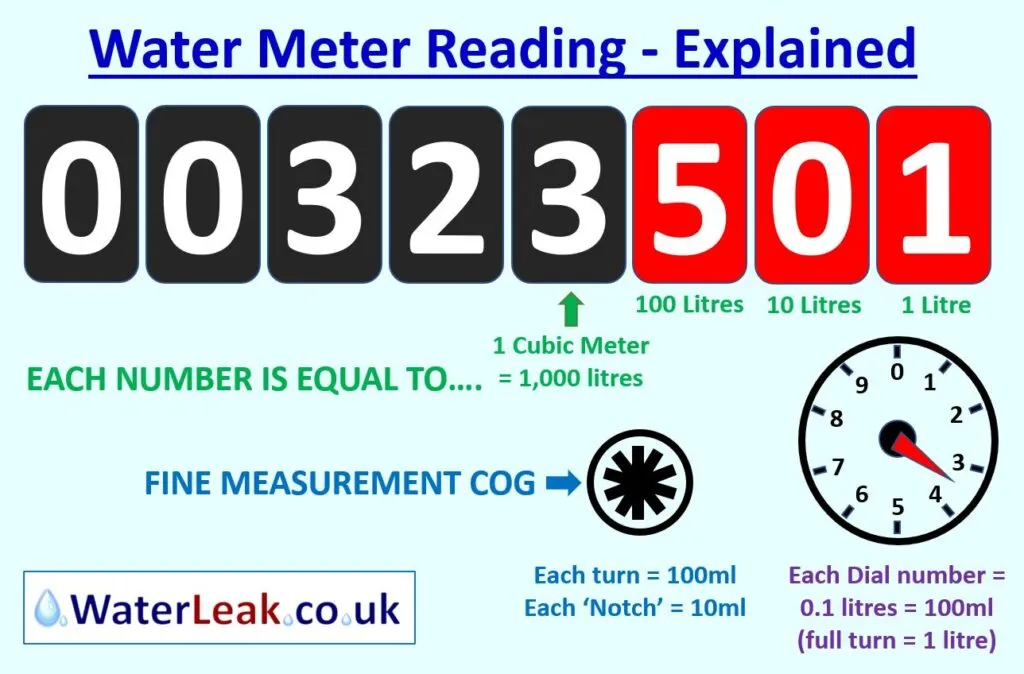
It is also worth checking the reading against the meter itself before doing anything else. Estimated readings, a meter changed on site, a digit transposed on an account and a shared meter serving more than one property all produce alarming numbers with no leak behind them. Our guide to reading your water meter to check for a leak covers what the dials and the digits are telling you.
Rule Out Ordinary Household Use First
Most high usage alerts have a mundane explanation, and working through them costs nothing. The pattern in the data usually gives it away.
| What the usage graph shows | Likely explanation | How to confirm it |
|---|---|---|
| A sustained step up that never returns to baseline | A continuous leak or a fixture passing water constantly | Run the isolation test below |
| Peaks at the same time each day, flat overnight | An irrigation timer, a water softener regenerating, a pressurised filter backwashing | Check timers and programmed appliances, then watch the affected slot |
| A fortnight of raised use that then stops | Visitors, a new appliance, a paddling pool, a filled pond, pressure washing | Match the dates against what happened in the house |
| Raised use only in hot or dry weather | Garden watering, hoses and sprinklers | Compare against the same weeks in a previous year |
| A gradual creep upward over months | A toilet or overflow passing slowly, or a dripping fitting | Dye test every toilet and inspect the external overflow pipe |
| One implausible spike, then normal | A meter reading error or an estimated reading | Take your own reading and compare it with the account |
The three fixtures that account for most of it
A toilet whose flush valve or float has failed passes water into the pan continuously and silently. Put a few drops of food colouring in the cistern, leave it thirty minutes without flushing, and if colour appears in the pan the toilet is the leak. A dripping tap is visible but easy to dismiss, and a dripping hot tap costs twice over because the water was heated. And an external overflow pipe dripping means a cistern or a cylinder is passing water to drain, which never shows up anywhere inside the house and can run for months unnoticed. Check the outside walls of the property after a dry spell, because a wet patch under an overflow outlet on an otherwise dry wall is unambiguous.
The Isolation Test That Settles It
This is the test that turns a suspicion into a fact, and it needs nothing but a stop tap and half an hour.
- Turn off every tap and appliance. No washing machine, no dishwasher, no ice maker, no irrigation, and nobody flushing anything.
- Take a reading at the meter, including every digit after the decimal point, and note the time.
- Leave the house undisturbed for thirty minutes to an hour.
- Take a second reading. If the figure has moved, water is leaving the system somewhere.
- Now find your internal stop tap and close it. Take a third reading, wait the same period, and read again.
- If the meter still moves with the stop tap closed, the leak is between the meter and the stop tap, which usually means the underground supply pipe. If it stops, the leak is inside the house.
If the small triangular or star-shaped flow indicator on the meter face keeps rotating with everything closed, you have the same answer faster. Our guide to a water meter that keeps spinning explains what the indicator responds to. If the stop tap will not turn or weeps once you move it, deal with that first: a seized stop tap turns a manageable incident into an emergency later.
Narrowing It Down Indoors
Once the isolation test says the leak is inside, the symptoms narrow the field quickly. Nothing here requires lifting a floor.
| What you notice | Likely source | What to check |
|---|---|---|
| A warm patch on a floor, or a floor that dries unusually fast | Hot supply or a heating circuit under the screed | Whether the boiler pressure falls and needs topping up |
| Boiler pressure dropping weekly | Heating circuit, radiator valve, or the pressure relief discharging | Radiator valve tails, the external pressure relief outlet, visible pipe runs |
| Damp at the base of a wall on the ground floor | Buried supply run, or water tracking along a pipe from elsewhere | Moisture pattern: a leak is wettest at a point, rising damp is even along a run |
| A stain on a ceiling below a bathroom | Waste, a seal, or a concealed supply pipe | Whether it worsens only after the shower is used, which points at a seal |
| Water in a cupboard under the sink or behind an appliance | Flexible hose, isolating valve, or waste trap | Braided hoses for bulging or rust, the trap connection for weeping |
| No visible symptom anywhere | Concealed supply pipe under a solid floor | The isolation test result, then a survey |
A leak with no symptom is not unusual. Water under a solid floor can run along the line of a pipe and leave the building without ever surfacing, which is why the meter often notices it months before anything else does. Our guide to the signs of a hidden leak covers the ones that are easy to miss.
Whose Pipe Is It, and Who Pays to Fix It
If the meter keeps moving with the internal stop tap closed, the next question is not how to fix it but whose pipe it is. Ofwat sets out the boundary for households, and it is not where most people assume.
| Section of pipe | Where it runs | Normally maintained by |
|---|---|---|
| Water main | Under the road or the footpath | The water company |
| Communication pipe | From the main to the boundary stop tap, usually at the property line | The water company |
| Supply pipe | From the boundary stop tap to the internal stop tap inside the property | The property owner |
| Internal plumbing | Everything beyond the internal stop tap | The property owner |
| Shared supply pipe | One pipe serving several properties | Shared between the owners it serves, which needs establishing early |
Many water companies will attend and check the external position, and some operate free or subsidised repair schemes for a first supply pipe leak. It is worth asking before commissioning anything, because the terms differ by company and by region. Where the pipe is shared with neighbours, sort out who is responsible before work is arranged rather than after. Our guide to underground supply pipe responsibility goes through the detail.
What to Do About the Bill
A leak on your own supply pipe still registers on your meter, which means you are billed for water you never used. Most water companies operate a leak allowance for metered household customers, usually applied once, usually conditional on the leak being repaired within a stated period, and usually covering both the water and the wastewater element. Ofwat publishes guidance on leakage and expects companies to have a published code of practice setting out what they offer.
What an allowance usually requires
The common conditions are worth knowing before you spend anything: the leak has to be on a pipe you are responsible for, it has to be repaired within the company's stated window, you have to supply evidence of the repair, and the allowance is normally a one-off rather than something that can be claimed repeatedly. Keep the invoice and any before and after photographs. In London, our guide to the Thames Water leak allowance covers how the regional scheme works.
When to Bring In a Detection Survey
A survey earns its keep at exactly two moments. The first is when the isolation test proves water is leaving the system but nothing indoors explains it, which usually means a concealed run under a solid floor. The second is when the alternative is guesswork with a floor saw.
The point of the survey is to locate the source without opening anything up, using acoustic equipment on pressurised runs, thermal imaging and moisture mapping across the affected area, and tracer gas where the floor build-up defeats the others. Where possible, anybody working on your plumbing should be qualified and, ideally, on an approved contractor scheme. The Drinking Water Inspectorate publishes advice on finding a plumber, and WaterSafe maintains the national register of approved plumbers. Any fitting installed on your supply has to comply with the Water Supply (Water Fittings) Regulations 1999.
What you should be left holding
Whoever carries out the survey, the output should be the same four things:
- A located source, described by the component that failed rather than by the room it is in.
- A record of which systems were tested, how, and which ones were ruled out.
- Photographs, and any thermal or moisture readings with the instrument that produced them.
- A clear statement of what has to be opened to reach the failure, and how much of it.
That last item matters more than it sounds. It is the difference between one agreed aperture and an afternoon of exploratory damage that somebody then has to make good.
Where Home Insurance Fits In
A high bill on its own is not an insurance matter. Most UK buildings policies respond to the damage water does, not to the cost of the water itself, so a supply pipe quietly losing water into the ground usually sits with the water company's leak allowance rather than with an insurer. It changes once the water has damaged something: a soaked floor, a wet ceiling, ruined belongings.
At that point most policies include a trace and access clause covering the reasonable cost of finding a hidden leak and making good the damage caused by the search, subject to a limit on the schedule. Notify the insurer before anything is opened up, and keep detection, access and repair on separate invoices. Where a claim is large enough for the insurer to appoint its own representative, our specification for leak detection for loss adjusters and insurers sets out what that professional will be looking for.
How we help with this
If the article describes a problem you actually have, these are the visits that deal with it.
- our full guide to leak detection
How each method works and when it is the wrong tool for the job.
- leak detection in London
Finding a hidden leak without opening the property up first.
- preventing the next leak
Where pipes fail in London homes and what actually reduces the risk.
Frequently asked questions
Does a high usage alert always mean I have a leak?
No. The alert reports volume passing the meter against a rule, not a diagnosis. Visitors, a filled paddling pool, garden watering, a water softener regenerating, a new appliance or an estimated reading all raise usage without any leak. What separates them is the shape of the graph. A step up that never returns to baseline, and especially flow continuing through the small hours, behaves like a leak. Peaks that fall back to a flat overnight baseline behave like people.
How do I check for a leak using my water meter?
Turn off every tap and appliance, take a full meter reading including the decimals, and note the time. Leave the house undisturbed for thirty minutes to an hour and read again. Any movement means water is leaving the system. Then close the internal stop tap and repeat. If the meter still moves, the leak is between the meter and the stop tap, which usually means the underground supply pipe. If it stops, the leak is inside the property.
Who pays to fix a leak on the pipe outside my house?
It depends which section of pipe it is on. Ofwat sets the boundary: the water main and the communication pipe up to the boundary stop tap are the water company's responsibility, and the supply pipe from that stop tap into the property is the owner's. Many companies will check the external position and some run free or subsidised repair schemes for a first supply pipe leak, so it is worth asking before commissioning any work. Shared supply pipes need sorting out early.
Can I get money back for water lost through a leak?
Usually, through a leak allowance. Most water companies operate one for metered household customers, typically once, typically conditional on the leak being repaired within a stated window, and usually covering both the water and the wastewater element of the bill. Ofwat expects companies to publish a code of practice setting out the terms. Keep the repair invoice and photographs, because evidence of the repair is normally a condition of the allowance being applied.
Why is there no damp anywhere if I have a leak?
Water escaping under a solid floor can track along the pipe trench and drain away into the ground without ever reaching a finished surface. Nothing stains, nothing smells, and nothing feels wet, which is why a metered supply is often the first thing to notice it. That is also why the meter test matters more than a visual inspection, and why a concealed leak with no symptoms usually needs locating with instruments rather than by looking harder.
Should I just have the floor opened up to find it?
Not as a first step. Exploratory opening-up is open-ended, has to be reinstated whether or not it found anything, and destroys the moisture pattern that would have shown where the water came from. A non-invasive survey narrows the search to a defined point first, so what gets opened is one agreed aperture rather than an afternoon of guesswork. It also leaves you with a written record of what was tested, which matters if anything is later disputed.