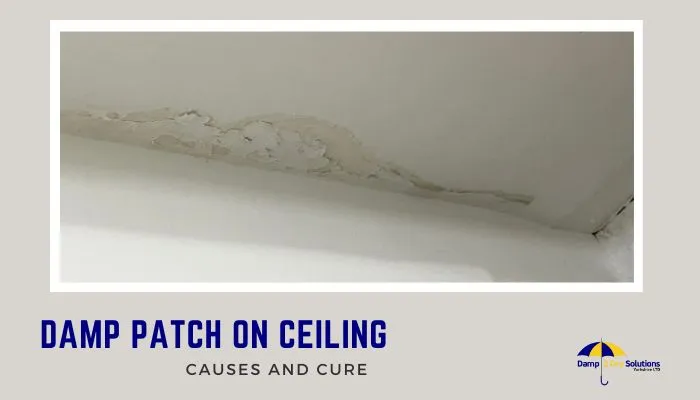
A stained ceiling is the cheapest part of the job. What actually decides the bill is how much has to come down, what the ceiling is made of, how long the structure above it takes to dry, and whether the source was ever properly found.
The visible stain is the cheapest thing in the room. What decides the cost of repairing ceiling water damage is everything behind it: how much has to come down, what the ceiling is built of, what got wet above it, how long that takes to dry, and whether the source was actually found before anybody started patching.
This guide sets out what you are paying for line by line, why the same-looking stain can produce very different jobs in two neighbouring properties, why the drying period rather than the repair sets the timetable, and the questions that turn a vague estimate into something you can compare.
What You Are Actually Paying For
Repairing a water damaged ceiling is a sequence of separate jobs, usually by different trades. The plastering is rarely the largest item, and it is always the last one.
| Line | What it covers | When it happens |
|---|---|---|
| Making safe | Isolating water and electricity, removing the risk of collapse, protecting the room | Immediately |
| Finding the source | Investigating what failed and where, before anything is opened | Before any repair |
| Repairing the source | The pipe, fitting, seal, appliance or roof detail that let water in | Once located |
| Strip out | Removing failed ceiling material, wet insulation and saturated contents | Once the source is isolated |
| Drying | Extraction, dehumidification, air movement and monitoring of the floor void and ceiling | Weeks, not days |
| Ceiling reinstatement | New boarding or replastering, sometimes reinstating insulation and services | After readings confirm dryness |
| Decoration | Sealing the stain, priming, painting, often the whole ceiling or room | Last |
The cheapest mistake is also the most expensive one
Painting over a stain without finding the source is the commonest thing people do and the most reliably costly. Water staining bleeds through emulsion, so the mark returns. More importantly, the leak is still running, so the area that eventually has to be replaced grows while the room looks fine. Our guide to a brown stain on a ceiling covers how to tell what you are looking at before deciding anything.
How Much of the Ceiling Has to Come Down
This is the single largest variable, and it is decided by the plaster rather than by the stain. Three thresholds matter.
Staining only, with the board sound
Where the ceiling is discoloured but firm, flat and not sagging, and readings confirm it has dried out, the work is a stain blocking primer and repainting. Ordinary emulsion will not hold back a water stain, so a purpose made stain block is required, and a partial repaint almost never matches, so a whole ceiling is usually repainted.
Localised failure
Where a patch has blown, cracked or lost its bond but the rest of the ceiling is sound, that section is cut out and made good. Cutting back to joists on each side is normal because the new board has to be fixed to something, so the repaired area is generally larger than the damaged area. Matching an existing textured or heavily skimmed finish across the join is the part that decides whether the repair is visible.
Full replacement
A ceiling that is sagging, that has taken a substantial volume of water, or that is lath and plaster which has lost its key is replaced rather than patched. This also becomes the sensible option where the joists above need inspecting, where insulation has to be removed, or where the patching would be so extensive that a new ceiling costs less than fighting the old one. A sagging ceiling holding water is also a safety matter rather than a cosmetic one, and our guide to water coming through the ceiling sets out the immediate actions.
Ceiling Construction Changes Everything
Two identical stains in two houses of different ages are two different jobs, because what is behind the paint is not the same material.
| Construction | Behaviour when wet | What it means for the repair |
|---|---|---|
| Modern plasterboard and skim | Softens locally, board loses strength where saturated | Straightforward cut out and patch, or full reboard |
| Lath and plaster | Water softens the plaster keys behind the laths and they break away | Frequently a full replacement. A ceiling that has lost its key can fail without warning |
| Textured coating applied before 2000 | Behaves like plaster but may contain asbestos | Needs identifying before disturbance. Work is governed by the Control of Asbestos Regulations 2012 |
| Ornate cornice, roses and mouldings | Detail is lost where plaster fails | Specialist fibrous plaster work, running or casting to match. A different trade and a different programme |
| Suspended or grid ceilings | Tiles sag and stain, grid may corrode | Tile replacement is simple, but matching an older tile range often is not |
| Insulated ceiling voids | Insulation holds water and stops the void drying | Wet insulation is removed and replaced, not dried in place |
| Downlights and recessed services | Water tracks to and through the openings | Electrical inspection required, and fire-rated fittings may need replacing |
The question worth asking before anyone scrapes anything
Textured decorative coatings applied before the UK ban on chrysotile in 1999 can contain asbestos. Disturbing one without identifying it first is a risk to everyone in the property and a regulatory problem for the contractor, because work on asbestos containing materials is governed by the Control of Asbestos Regulations 2012 and the Health and Safety Executive publishes the duty holder guidance. On any ceiling of the wrong age with a textured finish, sampling before disturbance is the correct sequence, and it is a small cost next to the alternative.
The Drying Period Sets the Timetable, Not the Repair
The repair date is not decided by when a plasterer is available. It is decided by moisture readings in the fabric above the ceiling, and that is the part of the programme most often compressed by somebody in a hurry.
What is wet is rarely just the ceiling. Water that came through a ceiling has usually passed through a floor build-up first, wetting boards, joists, insulation and sometimes the head of a party wall. Plasterboard surfaces dry comparatively quickly. Timber, screed and mineral insulation hold water for far longer, and the drying period is set by the slowest material, not the fastest.
What drying actually involves
- Extraction of standing water and removal of saturated, non-recoverable material such as wet insulation.
- Dehumidification to lower the vapour pressure in the room, with air movers to keep moisture leaving surfaces.
- Sometimes targeted drying into a floor void, which needs access points rather than simply running equipment in the room below.
- Readings taken at the start and at intervals, at the same points with the same instrument, against a dry reference elsewhere in the property.
- A defined end point, agreed in advance, rather than a decision that it looks dry enough.
It is worth knowing that PAS 64, the publicly available specification covering mitigation and recovery of water damaged buildings, was withdrawn without replacement, so there is no current British Standard governing domestic drying. That makes the written scope and the agreed target readings the only real control you have. Our guide to drying out after a water leak covers what to expect from the period.
Why finishing early costs more than waiting
Plastering and decorating over damp fabric traps moisture behind the finish. The result appears two to six months later as blown plaster, tide marks reappearing through paint, lifting tape at board joints or mould growth at the edges of the repair, and the work is then done twice. Prolonged damp also creates the conditions for mould, which turns a building repair into a remediation issue, as our guide to whether a water leak causes mould and damp explains.
What to Do Before Anyone Attends
The first hour changes the size of the eventual job more than anything a contractor does later, and none of it is technical.
Treat a bulging ceiling as a load, not a stain
A ceiling holding water is carrying weight it was never designed for, and plaster gives way without much warning. Keep people out of the room, move what can be moved from the doorway rather than from underneath it, and leave any decision to pierce and drain it to somebody who has assessed it on site. Furniture and electricals directly below should be relocated first, contents second.
Isolate water and electricity, in that order
Close the internal stop tap if the source is on your own supply, and switch off electricity to affected circuits at the consumer unit if you can reach it safely from a dry position. Water in a ceiling void means cables, junction boxes and recessed fittings, and a wet downlight is a live fitting until the circuit is off. Then photograph and video everything before anything is moved or mopped, because a record taken before the clean-up is worth more than anything produced afterwards.
What a Quote Cannot Include at the Start
Four things are genuinely unknown until the ceiling is open, and an estimate that does not say so is incomplete rather than competitive.
The true wetted extent
The stain marks where water arrived at the surface, not where it spread above. Readings taken once the void is accessible routinely show a wetted area considerably larger than the visible mark, and that area sets both the drying period and the reinstatement.
The condition of the structure above
Joist ends, noggins and the bearing into a wall can only be assessed once they are visible. Timber that has been wet for a long period may need treating or replacing, which moves the job from a finishes repair to a structural one.
The state of the electrics
Water and ceiling voids mean cables, junction boxes and recessed fittings. Whether anything needs replacing, and whether the circuit needs inspecting and testing, is an electrician's determination made on site, not a line anybody can price blind.
Whether the source is really fixed
If the ceiling was opened before the source was located, or the source was assumed rather than proven, the repair can be completed and the stain return. That is why investigating properly before patching is the cheapest part of the whole exercise, and our guide to a damp patch on a ceiling sets out how to establish what is actually happening.
Where Insurance Changes What You Pay
On most UK home policies the damage the water caused is an insured peril, while the failure that caused it often is not. That split, rather than the total, decides what comes out of your own pocket.
| Line | Typical position |
|---|---|
| Damage to the ceiling, decoration and contents | Covered under escape of water, subject to the excess |
| Finding the leak and making good the search damage | Usually within the trace and access extension, up to the limit on the schedule |
| Repair of the pipe, fitting or seal that failed | Commonly excluded as wear and tear |
| Water passing failed grout or sealant | Commonly excluded, because the water never left the plumbing system |
| Drying and monitoring | Usually covered as part of the damage claim |
| Upgrading a finish while it is open | Not covered. A policy restores rather than improves |
The two figures to read off your schedule
Escape of water frequently carries its own excess, separate from and often higher than the standard one, and trace and access is a monetary cap rather than an open commitment. Both are policy specific. Insurers are required by ICOBS 8.1.1R in the Financial Conduct Authority Handbook to handle claims promptly and fairly and not to reject them unreasonably, and where a claim is refused because the damage was gradual, the Financial Ombudsman Service publishes guidance on gradual damage that is worth reading before accepting the decision. If the water came from a flat above rather than your own pipework, our water leaking through a ceiling page sets out how those situations are handled.
Questions That Make Quotes Comparable
- Has the source been located and proven, or is this quote assuming it?
- Is the price for patching the damaged area, cutting back to joists, or replacing the ceiling?
- What is the ceiling made of, and has a textured coating of the wrong age been sampled?
- Is drying included, priced per day, or excluded, and what target readings end it?
- Who inspects the electrics and the joists once the ceiling is open?
- Is decoration to the repaired area only, the whole ceiling, or the whole room?
- What happens to the price if the wetted area turns out larger than expected?
- If I am claiming, will source investigation, access, repair, drying and reinstatement be invoiced separately?
That final question matters because those lines sit under different parts of a policy, and a single combined invoice is one of the commonest reasons a water damage claim gets queried rather than paid.
How we help with this
If the article describes a problem you actually have, these are the visits that deal with it.
- how our pricing works
What sets the fee for a survey, and what is confirmed before we travel.
- damp and moisture surveys
Moisture mapping that separates a leak from condensation or damp.
- our full guide to leak detection
How each method works and when it is the wrong tool for the job.
Frequently asked questions
Can I just paint over a water stain on the ceiling?
Only once the source is fixed and the fabric above has dried, and then only with a purpose made stain blocking primer, because ordinary emulsion will not hold back a water mark and the stain bleeds through. Painting while the leak is still running hides a problem that is getting larger, since the wetted area above keeps growing while the room looks tidy. A partial repaint also rarely matches, so in practice the whole ceiling usually gets recoated.
Does the whole ceiling have to come down?
It depends on the plaster, not the stain. Where the ceiling is discoloured but firm, flat and dry, it is a decorating job. Where a patch has blown or lost its bond but the rest is sound, that section is cut back to joists and reboarded. Full replacement becomes the answer where the ceiling is sagging, has taken a large volume of water, or is lath and plaster that has lost its key behind the laths, which can fail suddenly and without warning.
How long before the ceiling can be replastered and painted?
The date is set by moisture readings, not by the repair. Water that came through a ceiling has usually passed through a floor build-up first, wetting boards, joists and insulation, and the drying period is governed by the slowest material rather than the fastest. Finishing over fabric that is still damp traps moisture behind the plaster, and the result appears months later as blown plaster, returning tide marks or mould at the edges, which means paying for the same work twice.
Why is a lath and plaster ceiling more expensive to repair?
Because of how it fails. Lath and plaster works by plaster being pushed between timber laths so it forms keys behind them. Water softens those keys and they break away, so a ceiling can look intact from below while having lost much of what is holding it up. Patching a ceiling whose key has gone is unreliable, and the safe answer is usually full replacement, which brings strip out, waste removal and reboarding into a job that started as a stain.
Could my ceiling contain asbestos?
A textured decorative coating applied before the UK ban on chrysotile in 1999 can contain asbestos, and disturbing one without identifying it first is both a health risk and a regulatory problem. Work on asbestos containing materials is governed by the Control of Asbestos Regulations 2012, and the Health and Safety Executive publishes the relevant guidance. On any ceiling of the wrong age with a textured finish, sampling before disturbance is the correct sequence and a small cost against the alternative.
Will my insurance pay for the ceiling?
On most UK home policies the damage the water caused is covered under escape of water, subject to an excess that is often separate from and higher than the standard one. Finding the leak and making good the search damage usually sits within the trace and access extension, up to a limit stated on the schedule. What is commonly not covered is repairing the component that failed, and water passing failed grout or sealant is frequently excluded because it never left the plumbing system.